Before the Hallmark: How Silver Was Identified
Before the hallmark, silver identification relied on touch, trade knowledge and local marks; learn what each clue can establish and where it falls short.
Before the hallmark, a buyer judging a silver vessel had to ask a practical question: what is it made of, and who is willing to stand behind that claim? Silver identification was not one settled test. It was a changing mix of touch, observation, reputation and marks, with the balance shifting as trade widened and authorities sought firmer control.
For a present-day collector, the useful distinction is between evidence of material, evidence of origin and evidence of accountability. A mark might point to a maker, a workshop, a place or an official inspection; it did not always do all four. The best way to read an unmarked or partly marked object depends on the situation in front of you.
What does a mark actually identify?
A mark is a deliberate sign impressed, engraved or otherwise applied to an object. Its meaning depends on who placed it, when and under what local practice. A maker’s sign can associate a piece with a workshop, while a town or guild mark may indicate where a piece entered a recognised system. An assay mark, where an authority checked the metal, speaks more directly to the declared standard of fineness.
These roles can overlap, but they should not be collapsed into a single claim. A maker’s mark is not automatically proof that an object was independently tested; a decorative initial is not necessarily a maker’s mark at all. Before standardised hallmarking, marks were often local and inconsistent, and their interpretation depended on knowledge of a particular craft community.
That is why “before the hallmark” should not be taken to mean “before any marks”. Workshops, merchants and civic bodies used identifying signs in different places and periods. What changed was the reach and authority of the system: a locally meaningful stamp could become part of a more formal chain of identification, linking production, inspection and sale.
Which situation fits your object?
If the piece has no visible mark, what can you infer?
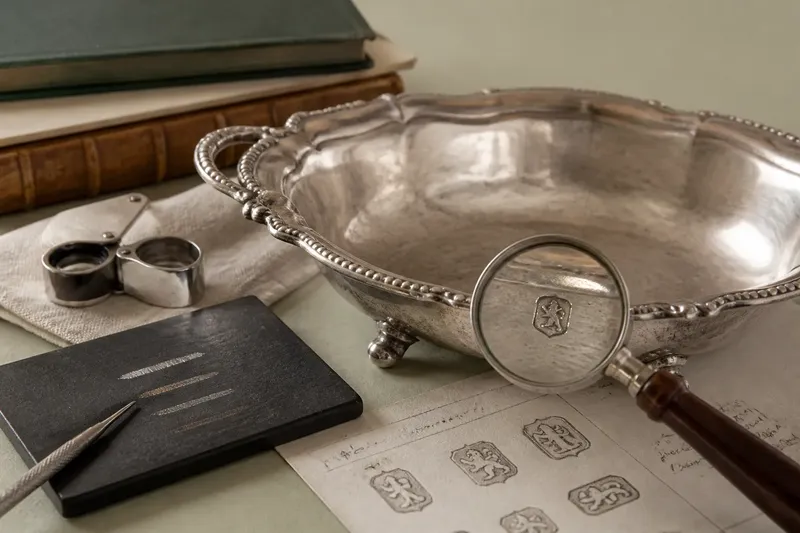
Absence of a mark is a limited clue, not a verdict on the metal. A mark may be hidden by wear, placed on a small fitting, omitted under a local custom or lost through alteration. Examine the object with good light and a hand lens, but treat its weight, colour and construction as observations rather than a reliable assay.
If you find a maker’s sign, what does it establish?
It can provide a lead to a workshop or maker, particularly when the sign matches a documented local form. It does not, by itself, establish the silver content or show that an independent authority inspected the piece. Look for accompanying marks and compare their placement and style with credible references for the relevant region.
If you find an official-looking stamp, is the fineness settled?
Not necessarily. A symbol may be a genuine assay mark, a private stamp, a later addition or a mark from a different system than you assume. The meaning must be read in its historical and geographical context, and the metal should be assessed separately if the result matters for a purchase, inheritance or sale.
How did people judge silver before formal testing?
In close-knit trades, experience carried considerable weight. A silversmith or dealer could recognise familiar alloys, workmanship and local conventions, while a customer might rely on the seller’s standing. Such knowledge was practical but uneven: skill varied, and a reputation could not make every transaction transparent, especially when goods travelled beyond the community that knew their makers.
Physical examination also offered clues. A skilled worker could consider how a piece was formed, how its surface behaved under ordinary use, and whether its construction matched objects known to be silver. But appearance alone is deceptive. Silver-coloured coatings and mixed materials can imitate the look of solid silver, while repairs and soldered joints complicate an otherwise convincing object.
Touchstones and related comparative methods offered another route. A small streak from the object could be compared with reference marks, with a reagent used to distinguish likely metal content. Such methods required judgement and could leave a trace; they were not an invisible, universal answer for every finished object. Their use belongs to a history of skilled trade, not to a casual home test.
Why did marks become more important?
As silver moved between workshops, markets and owners, personal familiarity became less dependable. A purchaser in one town might have no way to know the reputation of a distant maker. A public or guild-backed system could make a claim more legible: it offered a recognised sign that connected an object to a standard, a place or an accountable body.
That shift was not simply from trust to distrust. Marks made trust portable. They could help buyers compare goods and give authorities a way to regulate trade, while also serving makers who wanted their work recognised. The same system could impose obligations on craft workers and constrain how they sold their wares. Identification therefore reflects both commercial convenience and institutional power.
Formal systems did not instantly erase local practice. Marks could change, overlap or be understood differently across borders. An object might bear a workshop sign alongside an inspection mark, or carry a stamp added later in its ownership. The mark’s presence matters, but so does its relationship to the object’s construction and history.
What should you do with an uncertain piece?
Choose your next move according to what you need to know. If you are simply curious, start with careful visual documentation. Photograph all sides, fittings and marks in even light, and note where each sign appears. Record what is visible without expanding an uncertain shape into a confident reading.
If you are considering a purchase, ask the seller to distinguish clearly between a verified hallmark, an attributed maker’s mark and a description based only on appearance. For an object with financial or family importance, consult a reputable silver specialist or assay service; they can advise whether non-destructive examination is suitable or whether any test would affect the surface.
Say you inherit a small tray with a worn symbol beneath its rim. You photograph it, note that the mark sits beside a seam, and compare it with a regional reference rather than calling it an assay stamp. If the reference remains inconclusive, you ask a specialist to assess both the mark and the metal before assigning a firm identity.
- For an unmarked object: record its form and construction, then seek professional assessment if material certainty matters.
- For a readable maker’s mark: investigate the workshop and location, but do not treat attribution as proof of fineness.
- For several marks: identify each separately and consider whether they belong to one system or reflect later ownership.
- For a piece with repairs or mixed parts: ask whether different components may have different materials or histories.
- For a valuable or fragile object: avoid home scratch or chemical tests and consult a qualified specialist.
Marking conventions vary by place and period, and the relevant reference, assay service or specialist should guide any consequential identification.
Why does the distinction still matter?
Knowing how silver was identified helps prevent a mark from carrying more meaning than it can bear. A stamp may be a compact record of craft, trade and authority, but its message is never independent of context. The most responsible reading separates what the sign visibly says from what the object’s metal content still requires someone to establish.
For the history of silver, that distinction opens a broader view. Marks were not merely decoration or labels: they helped turn a material claim into something that could travel between strangers. When you encounter an old piece, begin by asking whose claim each mark represents. That question often reveals more than trying to force every symbol into the category of a hallmark.