Spoon, Fork or Serving Piece: Reading Silver by Its Shape
Learn to read silver tableware by shape, balance and intended use so you can choose a spoon, fork or serving piece that suits the task.
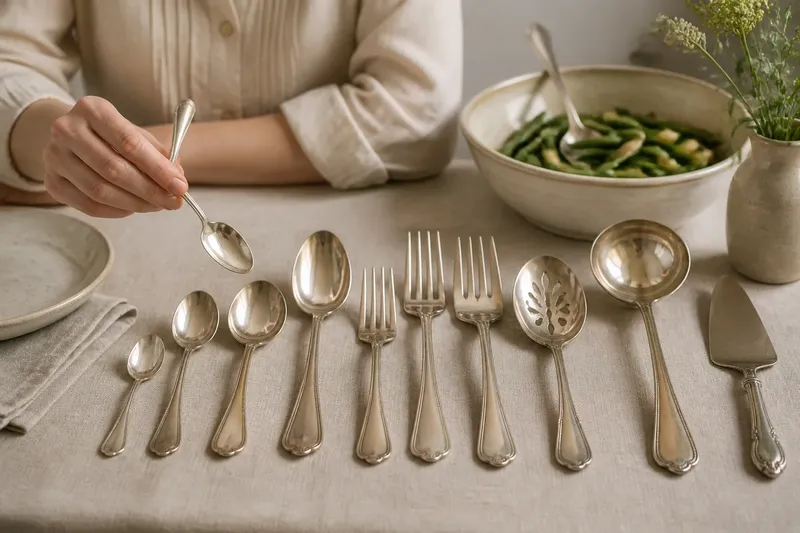
A silver spoon with a deep bowl behaves differently from a shallow one, even if both look alike in a drawer. Reading silver tableware by shape helps you judge what a piece was made to do, how it is likely to feel in use and whether it suits the task you have in mind.
What does the outline tell you?
Start with the working end: the bowl of a spoon, the tines of a fork or the blade of a serving implement. Its outline often gives a clearer clue to use than decoration does. A broad, rounded bowl can carry soft food; a narrow bowl is easier to manoeuvre in a cup or small dish.
Look at the transition from working end to handle. A gradual curve may let a spoon reach into a deep vessel, while a straighter neck can keep the hand farther from a hot dish. These shapes are clues, not proof of a single original purpose: makers and households used pieces in ways that suited their own service.
- Deep spoon bowl: suited to collecting liquid or loose food.
- Shallow, wide bowl: useful for lifting portions that need to stay relatively flat.
- Long handle: reaches into a tall glass, jar or serving vessel.
- Broad blade: can slide beneath a portion more readily than a narrow one.
How does a spoon’s bowl change its use?
A teaspoon-sized bowl is not simply a smaller version of a serving spoon. Its scale and depth suit individual portions, stirring or tasting, whereas a larger bowl can move food from a shared dish. The rim matters too: a softly rounded edge tends to feel different against the mouth from a pointed or unusually thin edge.
Consider the bowl in profile as well as from above. A pronounced curve holds more liquid than a flatter form; a pointed tip can guide a portion into a narrow opening. For a piece intended for a particular vessel, such as a sugar bowl or preserve jar, check whether the bowl and handle can reach inside without catching against the rim.
Imagine you are choosing a spoon for a narrow jam jar. A broad bowl may be awkward to turn inside it, so you choose a slimmer bowl with a longer handle; the observable result should be easier access to the bottom and sides, provided the spoon fits the jar’s opening.
What can a fork’s tines reveal?
Forks vary in the number, length and spacing of their tines. Longer, widely spaced tines can lift larger pieces or help separate food, while shorter tines may suit smaller bites. A fork with a broad head can support a portion across more of its surface; a narrow head offers a different, more precise grip.
Check the curve of the tines and the way they meet the head. A modest curve can help gather food, while straighter tines may pierce it more directly. A serving fork often has a larger head or a longer handle than a personal fork, but size alone is not enough to identify its intended job. Look for the overall relationship between head, neck and handle.
Balance also matters. Hold the fork near the point where the handle meets the head, then notice whether the weight feels concentrated at the end or spread along the piece. Neither balance is automatically better: a denser head may feel steady when lifting a portion, while a lighter piece can feel easier to guide.
How do serving pieces differ from personal cutlery?
Serving pieces are designed to reach into a shared dish and transfer food. Their handles are often longer, and their working ends may be broader or shaped to support a particular kind of portion. A serving spoon, for instance, needs enough bowl to lift food without spilling it; a pie server needs a flat blade that can slide beneath a slice.
Some shapes combine tasks. A slotted spoon lets liquid drain as food is lifted; a ladle’s deep bowl carries liquid; a fish slice has a broad, flat blade that can support delicate portions. The name can be a useful clue, but inspect the form itself: the shape tells you whether the piece can reach, lift, drain or support what you plan to serve.
Compare the handle with the working end before choosing. A large head on a short handle may feel cumbersome in a deep serving dish, while a long, narrow piece may be awkward for a broad platter. The piece should clear the vessel’s rim and leave enough handle to grip comfortably.
What should you look for before choosing silver tableware?
How can I judge whether a spoon is comfortable?
Hold it as you would during a meal and notice the handle’s width, edge and balance. Check that the bowl meets the mouth comfortably and is not so deep or wide that it feels awkward for the food you intend to eat.
Does a heavier piece work better?
Weight is a preference, not a reliable measure of usefulness or quality. Consider whether the piece feels controlled in your hand and whether its head stays manageable when carrying the portion it is meant to serve.
How do I tell a serving fork from a dinner fork?
Compare the size and shape of the head, the length of the handle and the piece’s likely reach into a shared dish. A serving fork commonly has a larger head or longer handle, but its form and intended task are better clues than one feature alone.
Can shape identify a piece’s original purpose?
Shape can suggest a use, but it may not settle the question, especially when several tasks suit the same form. Treat familiar names as starting points and judge whether the proportions make sense for the vessel and food involved.
How can you compare two pieces at the table?
Set the pieces beside the dish or cup where you expect to use them. Check whether each working end fits the opening, reaches the food and can lift a portion without striking the sides. Then hold each by its usual grip and compare how naturally the head follows your hand.
For a mixed collection, usefulness may matter more than matching patterns. A single well-shaped serving spoon can complement plain forks and spoons if its scale suits the dishes on your table. If the item’s name or use depends on a maker’s description, follow that information; otherwise, the shape itself remains a practical guide.
When reading silver tableware by shape, pay attention to the small transitions: bowl to neck, head to handle, and blade to rim. Those details help you choose a piece for the food and vessel at hand, while leaving room for the personal preferences that make everyday cutlery feel right.