Why Silver Tarnishes, and What the Surface Tells You
Why silver tarnishes: understand the surface chemistry, read its colour and texture, and distinguish ordinary tarnish from signs that need closer attention.
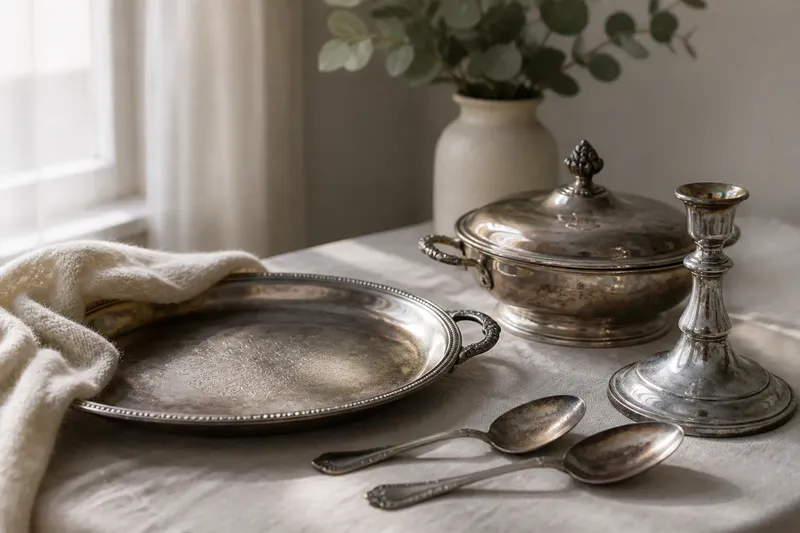
Why silver tarnishes is a question that often begins with a dark patch on a spoon or a grey cast across a candlestick. Tarnish is a change at the surface, usually formed when silver reacts with compounds in the surrounding air. It can reveal something about an object’s environment and use, but it is not a straightforward clock for age or a verdict on quality.
What is happening at the surface?
Silver is a metal, but objects described as silver are not all made in the same way. Some are made from a silver alloy, in which silver is combined with other metals. Others have a thin silver layer over a different base metal. That distinction affects how a surface responds to wear, but the familiar darkening associated with tarnish is generally a surface reaction rather than a transformation throughout the object.
In ordinary indoor conditions, silver can react with small amounts of sulphur-containing gases and other compounds. The reaction forms a thin layer of silver sulphide, which appears darker than bright, freshly cleaned silver. Moisture, air movement and nearby materials can affect how readily the surface changes. The resulting layer may be so slight that it first shows as a faint yellowish or brownish cast before becoming grey or nearly black.
“Tarnish” describes this discolouration, not one exact colour or one fixed thickness. A thin film can alter how light reflects from the surface, while a more developed film looks visibly dark. The name therefore covers a range of appearances, from a soft haze to sharply defined dark areas.
Why do some areas change before others?
An object does not meet its surroundings evenly. A hollow handle, a chased groove or the underside of a tray may receive less handling and air movement than an exposed, frequently touched area. Dust and residues can settle in recesses. The pattern of tarnish may follow these differences, leaving a bright ridge beside a dark line or a shaded area around a joint.
Contact matters, too. Materials stored beside silver can influence its surface if they release reactive compounds. Wool, some papers, certain elastics and some household products may contribute to a more reactive local environment. Food residues and fingerprints can also leave patches where the surface meets different substances. A mark that follows a contact point may say more about storage or use than about the object’s age.
Consider an invented situation: say you keep a silver-plated serving dish in a cupboard beside a woollen cloth, with the cloth touching one rim. If the rim develops a darker band while the exposed centre remains comparatively bright, the likely clue is uneven contact and local exposure, not that the rim is older or made from inferior silver. Moving the dish away from the cloth may help explain whether the pattern continues to develop in that particular spot.
What can colour and pattern tell you?
Colour offers clues, but it needs interpretation. A gradual grey or black film across exposed surfaces is consistent with ordinary tarnish. A golden or brown cast can be an earlier-looking stage of surface change, though colour alone cannot identify the exact reaction. Different lighting, reflections and the colour of nearby objects can also make a surface seem warmer or cooler than it is.
Pattern is often more informative than shade. Darkening concentrated in crevices may reflect areas that are harder to reach during handling or cleaning. A patch beneath a lid, near a handle, or where two pieces meet can point to trapped moisture, residue or contact with another material. None of these patterns proves a particular history; they are observations that help frame sensible questions about how an object has been kept.
Silver can also look dark by design. Makers sometimes leave recessed areas darker to bring out engraved, chased or embossed detail. This contrast may be intentional rather than a neglected film. If a dark area closely follows decorative recesses while raised details remain bright, its regularity may be a clue that the contrast belongs to the finish. Avoid treating every dark line as unwanted tarnish.
Does tarnish reveal an object’s age or quality?
Not by itself. An old object kept in a relatively protective setting may remain bright, while a newer one exposed to reactive materials may darken quickly. Storage, handling, air conditions and the object’s construction all affect the visible surface. Tarnish does not provide a dependable date, and a dark surface does not establish that an object contains more or less silver.
Nor does an even shine settle questions of quality. A bright surface may reflect recent cleaning, careful storage or a protective finish. A dark one may reflect ordinary exposure. To understand what an object is made from, look for appropriate marks and construction clues, but do not treat colour as a substitute for identification. A plated object can tarnish, and its visible surface may change differently from that of a solid silver alloy.
Wear can complicate the reading. On a plated object, repeated contact or past polishing may expose the base metal in places, often where the surface projects or is frequently touched. That is not the same as tarnish: tarnish is a film on the surface, while worn plating is a loss of the silver layer. Colour changes that persist as distinct underlying patches may warrant closer examination rather than more polishing.
How can you tell tarnish from other surface changes?
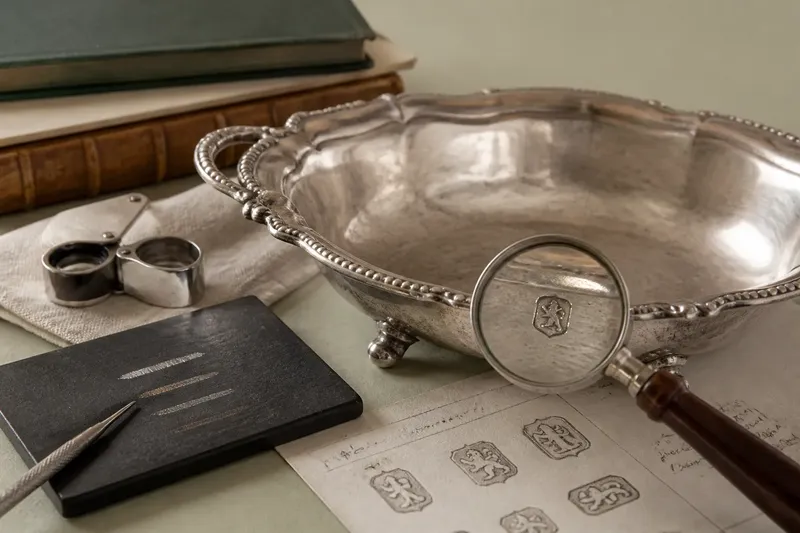
Start by looking without rubbing. Notice whether the colour forms a film over the surface, follows a contact pattern, or appears where the silver layer may have worn away. Check the object in neutral daylight if possible, since warm indoor lighting can distort subtle colour differences. A magnifying glass can help distinguish a smooth colour shift from scratches, pits or a flaky coating.
Different conditions can overlap. Tarnish may sit beside scratches from use, residue from food or polish, and areas of worn plating. A persistent greenish deposit, bubbling, lifting or a sharply contrasting patch is not a reliable sign of ordinary silver tarnish. It may relate to another metal, a coating, contamination or previous repair. Avoid scraping or applying a chemical cleaner to find out; a conservator or a reputable silver specialist can assess an object whose material or finish is uncertain.
- Look at the distribution: note whether darkening lies in recesses, on exposed areas or at a point of contact.
- Look for texture: a smooth film differs from raised residue, flaking, pits or a rough patch.
- Compare raised and recessed details: consistent contrast following decoration may be intentional.
- Check for exposed base metal: a distinct colour at rubbed edges may indicate worn plating rather than tarnish.
- Record the appearance: a clear photograph in consistent light can help you notice later changes without repeatedly handling the object.
What questions help make sense of a tarnished surface?
Is black silver always badly damaged?
No. Darkening can be a surface film, and a deep colour alone does not show whether the object has lost material. Look for accompanying signs such as flaking, pitting or exposed base metal before deciding what the surface may require.
Can tarnish appear on silver plate?
Yes. A plated object has a silver surface that can tarnish, though wear may also thin or remove that layer. The distinction matters because cleaning away a film is different from replacing silver that is no longer present.
Does a bright object have to be newer?
No. A bright surface may result from protective storage or previous cleaning, while an older object can remain relatively unchanged in a suitable setting. Shine is evidence of appearance, not a dependable record of age.
Should every dark recess be cleaned?
Not necessarily. Dark recesses can be part of the intended contrast in engraved or chased decoration. If the object’s finish is uncertain, preserve the surface as it is until someone qualified can assess it.
What does a change over time mean?
A surface becomes more informative when you compare it with its own earlier appearance. A photograph can show whether darkening is spreading, gathering at a contact point or remaining stable. That record is not a scientific diagnosis, but it can distinguish a longstanding pattern from a recent change and make a later conversation with a specialist more precise.
For many objects, the useful question is not simply whether tarnish is present, but what else the surface is telling you: where the change sits, whether it has texture, and whether the silver layer appears intact. Why silver tarnishes has a clear chemical answer, yet each object’s pattern reflects its particular surroundings and construction. Reading those clues carefully helps separate ordinary surface change from wear, decoration or a condition that deserves expert attention.
For a silver object you value, keep a note of its current appearance before making a decision about treatment. A quiet record of colour, pattern and texture can preserve useful information that a freshly polished surface would erase.